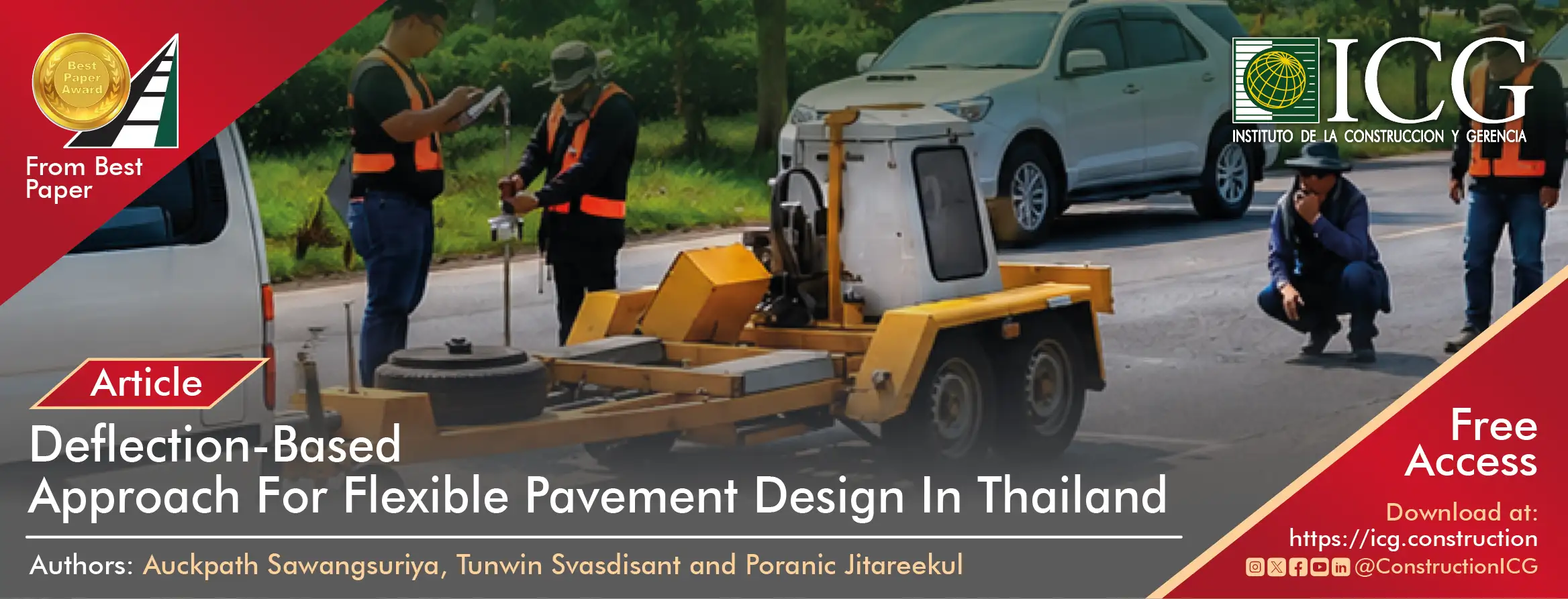
Deflection-Based Approach For Flexible Pavement Design In Thailand

Abstract: The Department of Highways (DOH), Thailand, has adopted both empirical and mechanistic approaches for flexible pavement analysis and design. Recently, the deflection-based design approach has been comprehensively reviewed by the DOH for the possible adoption of national design standards and practices. One of the key reasons is that Thailand’s road authorities, i.e., the DOH and the Department of Rural Roads (DRR), have considered the falling weight deflectometer (FWD) for the new construction and rehabilitation of road pavements. In addition, the FWD is widely accepted as the non-destructive test for deflection measurement and structural capacity evaluation. Ultimately, the implication of FWD deflections for in-house pavement analysis and design shall be developed and proposed to Thailand’s road authorities. Therefore, this study presents the deflection-based approach of flexible pavement design in Thailand. The FWD and a standard Thai truck were selected as the main loading applications in this study. A typical FWD loading stress of 700–800 kPa was practically adopted by the DOH and compared with a standard 10-wheel 25-ton truck with a tandem axle-dual wheel configuration with a tire pressure of 690 kPa. The layered elastic analysis was performed to calculate the pavement responses. The results suggest that the flexible pavement design based on a deflection-based approach is simple, practical, and conservative.

Keywords: civil infrastructure systems; management humanistic approach; smart city; sustainability;
5‑dimensional model; BIM‑CIM; digital twin; Peru

A video lecture is available for this article, which you can watch at the virtual 5-ICTI Conference.
You can purchase your access here.

Please note: This text is an abstract/summary. The complete original paper is available for download via the links at the bottom of this page.

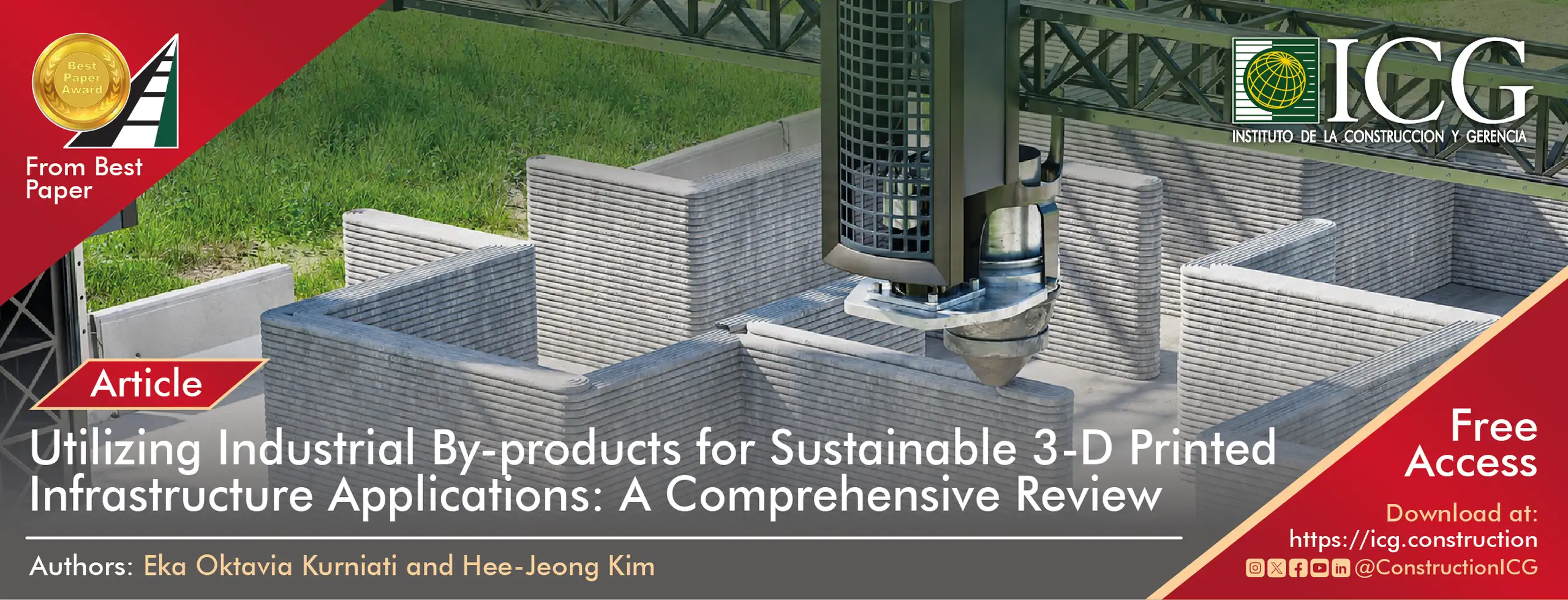
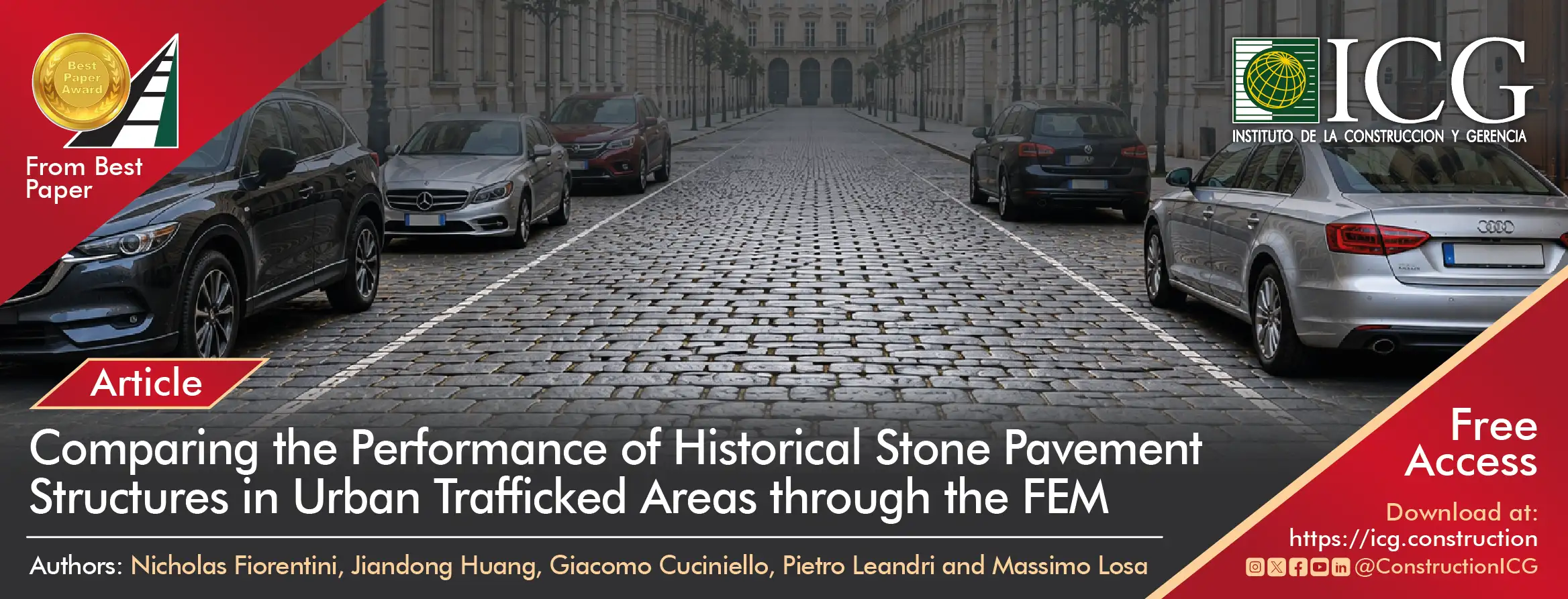
Utilizing Industrial By-products for Sustainable 3-D Printed Infrastructure Applications: A Comprehensive Review

Abstract: Industrial secondary products (e.g., fly ash, blast furnace slag, and silica fume) have found extensive application as alternative construction materials in conventional manufacturing methods to reduce carbon emissions due to cement usage and solve the waste management problem. To date, additive manufacturing or 3D printing has been massively developed for every material, including cement-based materials. Some possibilities have arisen to incorporate industrial wastes in cement mixtures in 3D printing applications. However, a comprehensive study about fly ash (FA), ground granulated blast-furnace slag (GGBFS), and silica fume (SF) usage in 3D-printed materials needs to be conducted. This paper shows that some aspects of 3D printing, such as printability, buildability, and rheological properties, need to be considered, and waste materials affect these fresh mixture properties. Applying waste materials as supplementary cementitious materials also gives different mechanical properties and durability performances. Furthermore, the environmental and economic benefits of 3D-printed and conventional materials are compared. The results show that 3D printing methods can enhance the environmental and economic benefits while maintaining the performance of materials created using traditional methods. Studying industrial waste application in 3D printing has become a promising way to develop sustainable materials in this digitalization era.

Keywords: fly ash; blast furnace slag; silica fume; 3D printing

A video lecture is available for this article, which you can watch at the virtual 5-ICTI Conference.
You can purchase your access here.

Please note: This text is an abstract/summary. The complete original paper is available for download via the links at the bottom of this page.
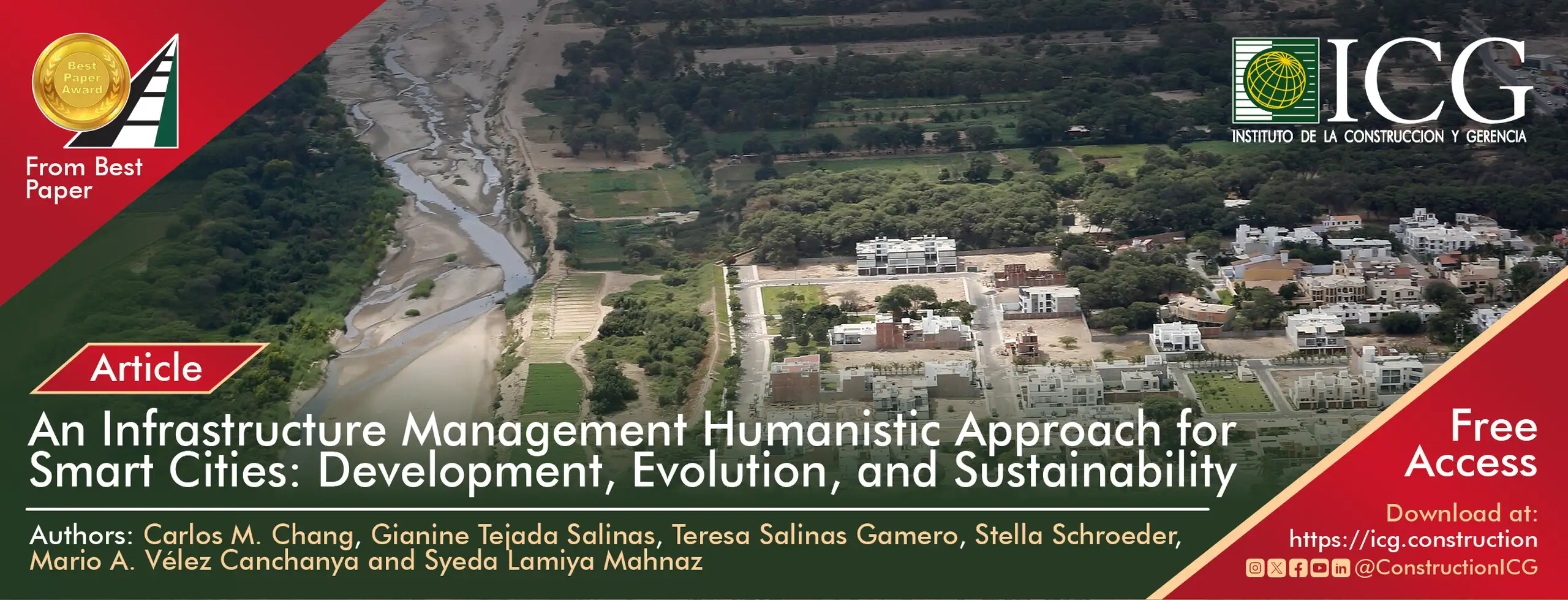
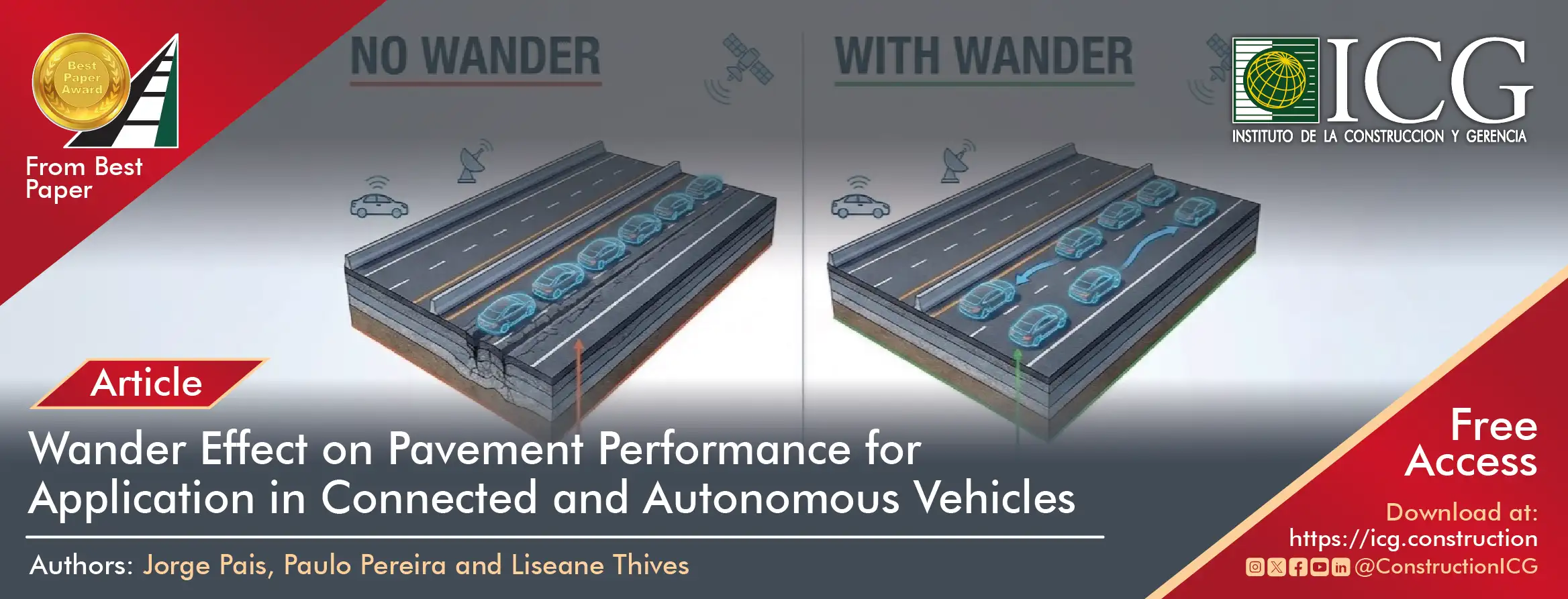
An Infrastructure Management Humanistic Approach for Smart Cities: Development, Evolution, and Sustainability

Abstract: Over the next decades, people will continue moving to urban areas all over the world, increasing infrastructure needs to satisfy economic, environmental, and social demands. The connection between civil urban infrastructure and smart cities is strong due to the common goal of fulfilling public service demands. Infrastructure management contributes to the development, evolution, and sustainability of smart cities. The main problem with traditional approaches to the development, evolution, and sustainability of smart cities is the lack of a holistic, integrated vision of infrastructure management. The main objective of this research is to introduce an infrastructure management humanistic approach with a smart city conceptual model that also considers an educational perspective. A mixed research methodology that combines quantitative and qualitative approaches was used, applying inductive‑deductive tools. The paper concludes with the development of an infrastructure management framework for smart cities with five dimensions: (1) Environmental, (2) financial‑economic, (3) political‑governance, (4) social‑people, and (5) technological. Two case studies for the cities of Lima and Piura in Perú illustrate how to incorporate this framework into practice. The research products are relevant because they foster an inclusive better quality of life for all citizens by preserving civil infrastructure systems.

Keywords: civil infrastructure systems; management humanistic approach; smart city; sustainability;
5‑dimensional model; BIM‑CIM; digital twin; Peru

A video lecture is available for this article, which you can watch at the virtual 5-ICTI Conference.
You can purchase your access here.

Please note: This text is an abstract/summary. The complete original paper is available for download via the links at the bottom of this page.
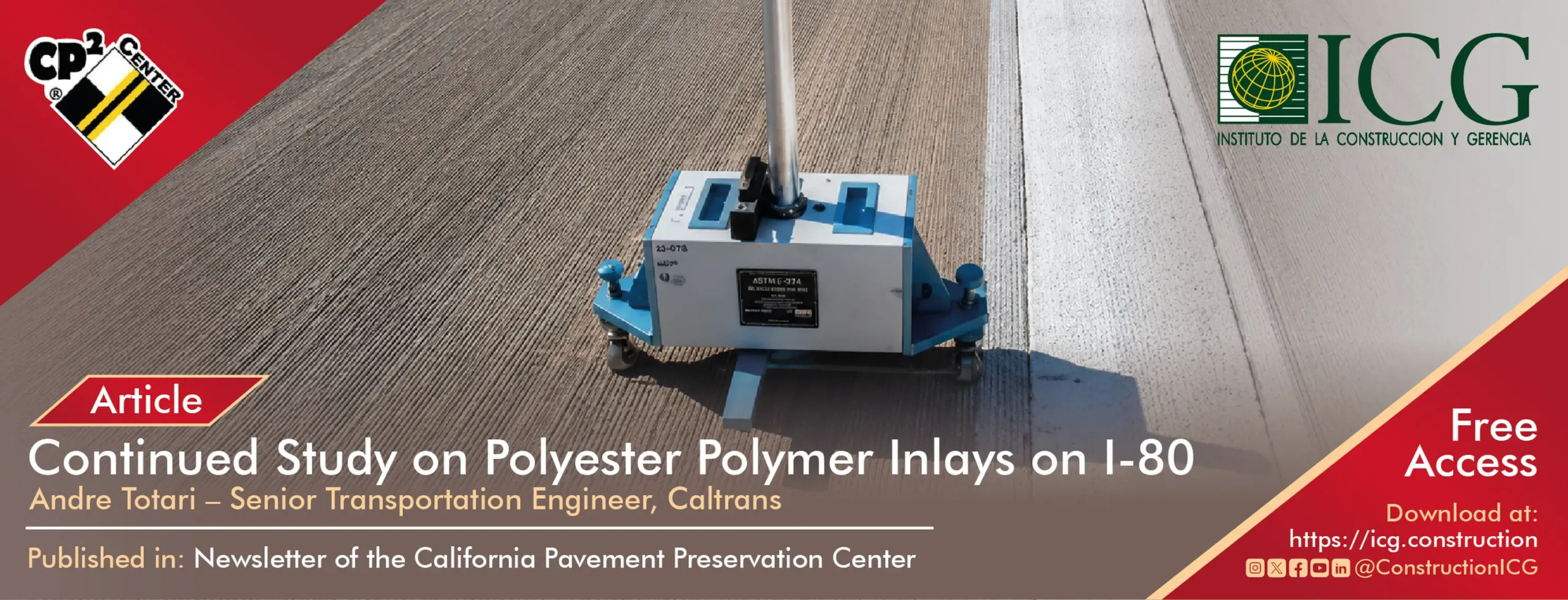
Cover of the article 'Continued Study on Polyester Polymer Inlays on I-80' by Andre Totari, published by the California Pavement Preservation Center and shared by ICG.

Continued Study on Polyester Polymer Inlays on I-80

Interstate 80 (I-80) in California faces severe concrete pavement wear due to heavy truck traffic and winter tire chain use, especially through the Sierra Nevada mountain range. This damage, called “wear depth,” differs from typical asphalt rutting, and has been difficult to control with previous repair methods.

In 2023, Caltrans initiated a pilot project near Donner Summit to evaluate polyester polymer concrete (PPC) inlays as a more durable pavement solution for high-wear conditions. These resin-based materials offer high strength, rapid curing, and strong resistance to cracking and extreme weather, making them well-suited for extending concrete pavement life without full reconstruction.

The project consists of multiple test sections, including control sections built with standard materials and experimental sections incorporating alternative formulations. The experimental approaches included the use of bauxite aggregate (selected for its superior hardness and finer aggregate size) blended with standard polyester resin, as well as an epoxy-based material known as Fastrac HPC. Data collection measured pavement wear depth using Face Dipstick Profiler

Please note: This text is an abstract/summary. The complete original newsletter is available for download via the links at the bottom of this page.
3rd Conference on MAIntenance and REhabilitation of constructed INFRAstructure facilities

Dear iSMARTi Members and Friends

We are pleased to share news of an important international event Co-sponsored by iSMARTi in 2026.

  • 3rd Conference on MAIntenance and REhabilitation of constructed INFRAstructure facilities
    Date: July 28th to July 30th, 2027
    City: Guimarães, Portugal
    Organized by: University of Minho
    Co-sponsored by: iSMARTi
    Chairs: Jorge Pais, Paulo Pereira and David Lee
    Details and Registration: https://maireinfra27.org/papers
  • The Call for Papers for the upcoming MAIREINFRA27 conference is now open.

Feel free to share this event with your networks!

This conference will provide an excellent forum for researchers, practitioners, public agencies, and industry leaders to exchange knowledge and best practices related to the maintenance, rehabilitation, and long-term performance of infrastructure systems.

We encourage our members and partners to consider participating in this high-impact international forum. Additional information, including registration details, will be available at website: www.civil.uminho.pt/maireinfra27

10th Anniversary of Infrastructures

The year 2026 marks the 10th anniversary of Infrastructures, a peer-reviewed open access journal on infrastructure engineering. With an Impact Factor of 2.9 and a CiteScore of 6.0, the journal is covered in Scopus, ESCI (Web of Science), Inspec and other databases. The journal has published more than 1300 papers from more than 4400 authors. More than 3000 reviewers have reviewed the journal at least once. We equally value the contributions made by our editors, authors, and reviewers.

In honor of the journal’s 10th anniversary, we are reflecting on our past accomplishments and embarking on an exciting new chapter. We invite you to join us in celebrating this milestone for our journal and to explore the content that we have prepared for you below.

Feel free to share this new with your networks!

For additional we have a website: https://www.mdpi.com/journal/infrastructures/anniversary

7th International Symposium on Pavement and Bridge Life Cycle Assessment

Dear iSMARTi Members and Friends

We are pleased to share news of an important international event Co-sponsored by iSMARTi in 2026.

  • 7th International Symposium on Pavement and Bridge Life Cycle Assessment
    Date: September 30th to October 2th, 2026
    City: Palermo, Sicily, Italy
    Organized by: The Università degli Studi di Palermo
    Co-sponsored by: iSMARTi
    Details and Registration: RoadLCA2026.

Feel free to share this event with your networks!

RoadLCA2026 will serve as a global meeting point for researchers, engineers, public agencies, and industry leaders committed to advancing sustainability, resilience, and decarbonization in road and bridge infrastructure. With a strong emphasis on life-cycle thinking—from design and materials to construction, maintenance, and end-of-life—the symposium will foster knowledge exchange, international collaboration, and the sharing of best practices that will shape the future of transportation systems worldwide.

We encourage our members and partners to consider participating in this high-impact international forum. Additional information, including registration details, is available at the RoadLCA2026 symposium website: https://roadlca2026.unipa.it

XXII Congreso Internacional Infraestructura Vial & EXPO Vial y Transporte 2025 – CONVOCATORIA

ICG, Instituto de la Construcción y Gerencia, tiene el agrado de invitar a los Profesionales de la infraestructura vial y transporte a participar en este gran evento que traerá beneficios muy importantes y actualización en todas las áreas de la Infraestructura Vial.

Numerosos expositores presentarán sus últimas innovaciones, brindando a los asistentes la oportunidad de aprender sobre una amplia gama de nuevos proyectos, servicios, tecnologías y normas.

El congreso tiene como objetivo divulgar los avances, investigaciones y proyectos innovadores a la comunidad profesional.

SHERATON HOTEL – LIMA
Av. Paseo de la Republica 170, Lima Perú

  • Sistemas de Gestion de Carreteras
  • Pavimentos de Asfalto
  • Pavimentos de Concreto
  • Mantenimiento y Rehabilitacion Vial
  • Concesiones Viales
  • Transporte e Infraestructura
  • Transporte Urbano, Diseño Geometrico
  • Seguridad Vial
  • Transporte Inteligente ITS
  • Aeropuertos, Ferrocarriles
  • Smart City, BIM
  • Gestion de Riesgos
  • Diseño Mecanístico Empírico de Pavimentos

Informacion XXII Congreso Internacional Infraestructura Vial & EXPO Vial y Transporte 2025
ver aquí >> www.construccion.org

Nuevas Tecnologías para la Evaluación y Gestión de Pavimentos:  Drones y Sensores Remotos

La presentación explora metodologías y tecnologías avanzadas para la evaluación y gestión de los pavimentos a lo largo de su ciclo de vida. Los temas principales incluyen la evaluación del desempeño funcional y estructural de los pavimentos, la integración de herramientas modernas como drones, sensores remotos e imágenes infrarrojas, y su aplicación para mejorar la eficiencia y precisión en la recolección e interpretación de los datos. La presentación destaca la importancia de la evaluación de pavimentos en las fases de planificación, construcción, mantenimiento y rehabilitación, con el objetivo de mejorar la funcionalidad y durabilidad de las vías optimizando los recursos disponibles. Aplicaciones de técnicas innovadoras de avanzada son presentadas con ejemplos de cómo estas herramientas contribuyen al desarrollo integral de una infraestructura vial sostenible.

Ingreso libre:

Link de inscripción:  https://assets.eafit.edu.co/GestionPavimentos-20241125

Ponentes:

Carlos M. Chang, Ph.D. P.E.

Florida International University

El Dr. Chang es Profesor Asociado en el Departamento de Ingeniería Civil y Ambiental de la Florida International University (FIU). Es Presidente de la International Society of Maintenance and Rehabilitation of Transportation Infrastructure (iSMARTi), Presidente del Comité de Gestión de Activos de la International Road Federation (IRF) y secretario del comité Florida Engineers in Education. Fue Presidente del Comité de Sistemas de Infraestructura de la ASCE. La investigación del Dr. Chang se centra en desarrollar conceptos, metodologías y herramientas prácticas de gestión e ingeniería innovadoras que equilibren las dimensiones económicas, ambientales y sociales.

Mas información…

Javier Gomez Sanchez

Universidad Autónoma de Querétaro

Master en Ingeniería y Operación de Drones por la Universidad Isabel I, España; Maestría en Ingeniería y Operación de drones por la Universidad Tecnológica TECH Mexico; Maestria en Economía y Finanzas (Instituto Suizo Universidad, México).  Máster en Inteligencia Artificial Aplicada en ThePower Business School  (España). Piloto Profesional y Observador de Sistemas de Aeronaves no tripuladas UAS/RPAS/DRONE (Escuela Aeronáutica de Colombia – APD Latinoamérica). Creador de TerraDRONEology ®

Darwin Rosero Vega

Alcaldía de Itagüí

El Magister en Ingeniería Civil Darwin Rosero Vega está vinculado a la Alcaldía de Itagüí como Jefe de la Oficina de Ejecución de Proyectos, Supervisión e interventoría; y está bajo su dirección la Gestión de Pavimentos de la red vial de Itagüí y su infraestructura asociada. Cuenta también con estudios de especialización de Vías y Transporte y formación académica en Sistemas de Información Geográfica. La investigación del Mag. Rosero Vega se basa en generar procedimientos de toma de decisiones en una red vial urbana mediante el uso matrices multicriterio y de algebra de mapas en SIG, lo que permite planificar la priorización de las intervenciones viales con presupuesto limitado.

Smart Sustainable Cities 2025: Pioneering Novel Frontiers for Green Urban Living

Dear iSMARTi Members and Friends,

I am delighted to invite you to join our upcoming Smart City events sponsored by iSMARTi in 2025.

  • Smart Sustainable Cities 2025: Pioneering Novel Frontiers for Green Urban Living
    Date: March 5–7, 2025
    Format: Online
    Organized by: SCIFORUM
    Co-sponsored by: iSMARTi
    Details and Registration: Smart Sustainable Cities 2025
    Discount: A 20% discount is available for iSMARTi members.

Feel free to share this event with your networks!

SSC 2025 is an event dedicated to pioneering novel frontiers for green urban living, and will host a diverse meeting of opinion leaders, researchers, industry experts, and policymakers from around the globe.