
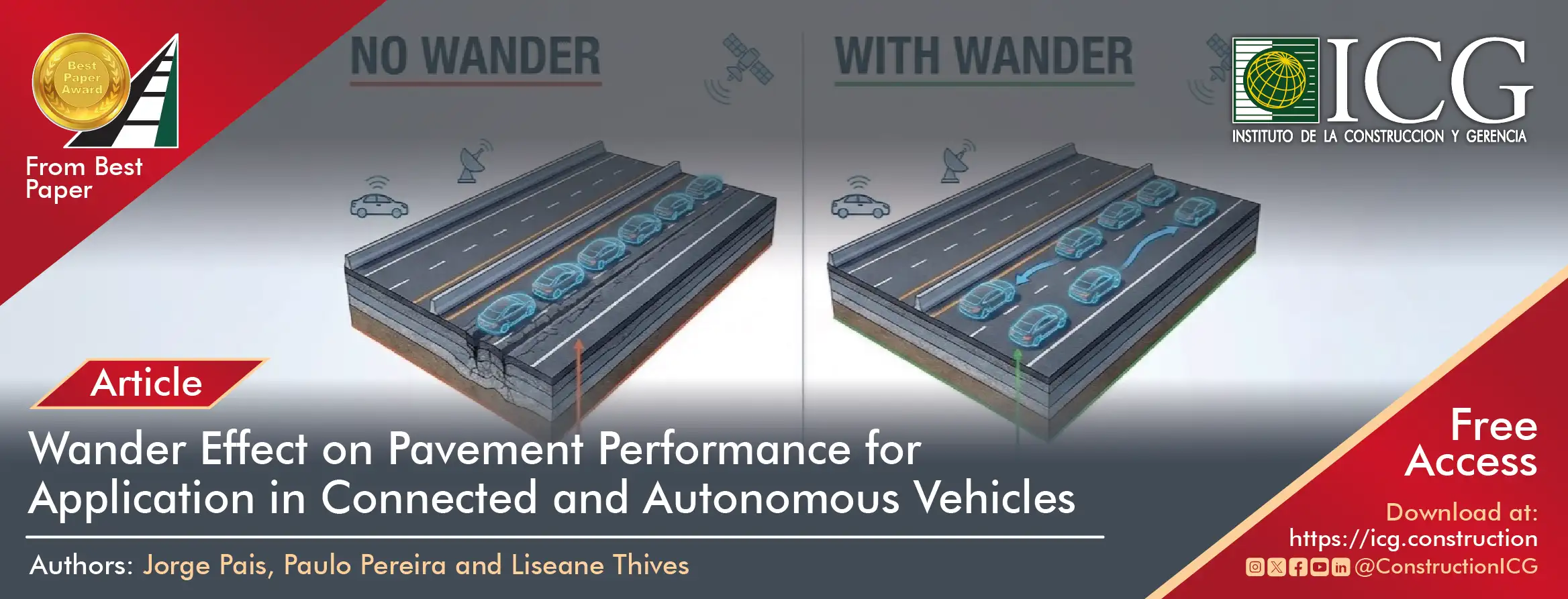
Abstract: Connected and Autonomous Vehicles (CAV) will change how road engineers design road
pavements because they can position themselves within a traffic lane, keeping their position in the
lane more precisely than human-driven vehicles. These vehicles will have lower lateral wandering,
which can induce more damage to pavements, such as cracking and permanent deformation, than
the conventional vehicles, with consequences for the infrastructures due to the increased cracking
and reduced safety due to the rutting. Thus, it is essential to assess the wander effect on pavement
performance to define policies for its implementation on CAV. This paper studies the impact of
the lateral wander of the traffic on pavement performance, considering its fatigue and permanent
deformation resistance. This impact can be used to define limits for the wander to minimize distresses
on the pavement. The results of this study allow us to conclude that for a pavement with a 10 cm
asphalt layer, the wander effect is more significant for fatigue life. A pavement life increase of 20%
was observed for a wander of 0.2 m, while for 0.6 m, the fatigue life can increase up to 48%. For the
permanent deformation, a pavement life increase of 2% for a wander of 0.2 m was observed, but for
0.6 m, the pavement life can be increased up to 34%.
Keywords: road pavements; connected and autonomous vehicles; wander; pavement performance
A video lecture is available for this article, which you can watch at the virtual 5-ICTI Conference.
You can purchase your access here.
Please note: This text is an abstract/summary. The complete original paper is available for download via the links at the bottom of this page.