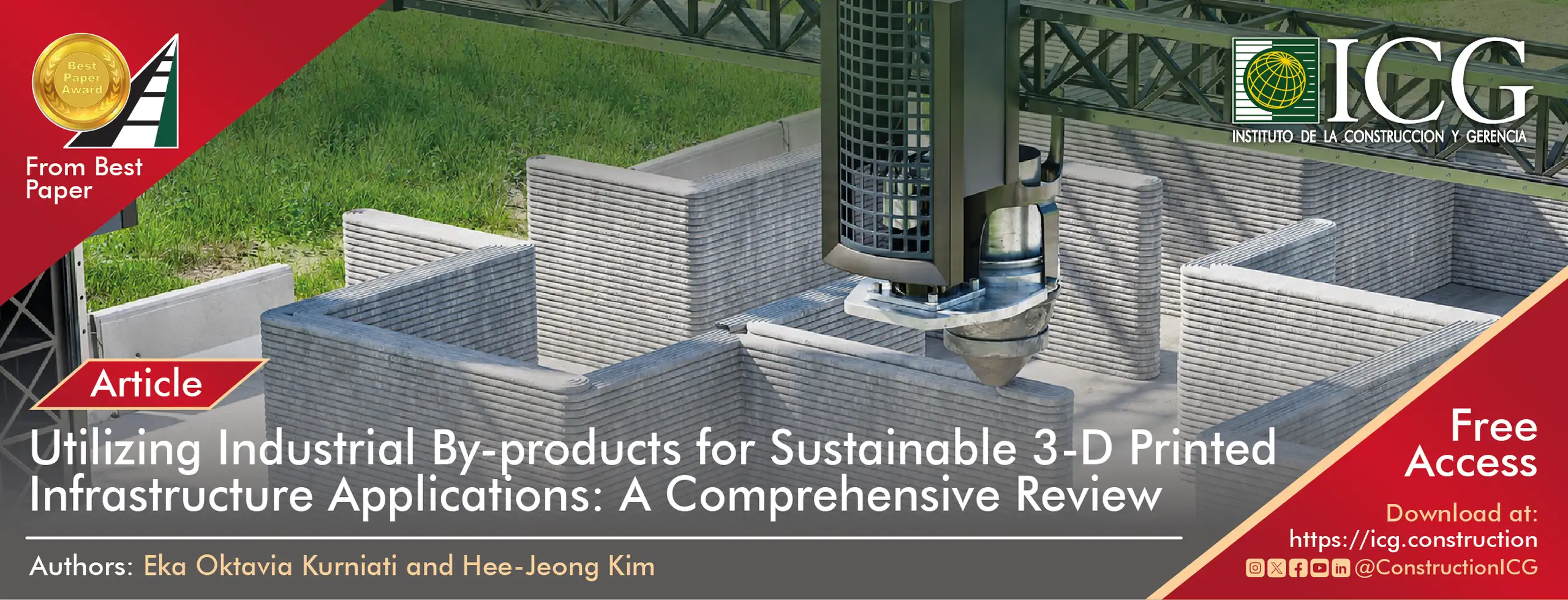
Utilizing Industrial By-products for Sustainable 3-D Printed Infrastructure Applications: A Comprehensive Review

Abstract: Industrial secondary products (e.g., fly ash, blast furnace slag, and silica fume) have found extensive application as alternative construction materials in conventional manufacturing methods to reduce carbon emissions due to cement usage and solve the waste management problem. To date, additive manufacturing or 3D printing has been massively developed for every material, including cement-based materials. Some possibilities have arisen to incorporate industrial wastes in cement mixtures in 3D printing applications. However, a comprehensive study about fly ash (FA), ground granulated blast-furnace slag (GGBFS), and silica fume (SF) usage in 3D-printed materials needs to be conducted. This paper shows that some aspects of 3D printing, such as printability, buildability, and rheological properties, need to be considered, and waste materials affect these fresh mixture properties. Applying waste materials as supplementary cementitious materials also gives different mechanical properties and durability performances. Furthermore, the environmental and economic benefits of 3D-printed and conventional materials are compared. The results show that 3D printing methods can enhance the environmental and economic benefits while maintaining the performance of materials created using traditional methods. Studying industrial waste application in 3D printing has become a promising way to develop sustainable materials in this digitalization era.

Keywords: fly ash; blast furnace slag; silica fume; 3D printing

A video lecture is available for this article, which you can watch at the virtual 5-ICTI Conference.
You can purchase your access here.

Please note: This text is an abstract/summary. The complete original paper is available for download via the links at the bottom of this page.
An Infrastructure Management Humanistic Approach for Smart Cities: Development, Evolution, and Sustainability

Abstract: Over the next decades, people will continue moving to urban areas all over the world, increasing infrastructure needs to satisfy economic, environmental, and social demands. The connection between civil urban infrastructure and smart cities is strong due to the common goal of fulfilling public service demands. Infrastructure management contributes to the development, evolution, and sustainability of smart cities. The main problem with traditional approaches to the development, evolution, and sustainability of smart cities is the lack of a holistic, integrated vision of infrastructure management. The main objective of this research is to introduce an infrastructure management humanistic approach with a smart city conceptual model that also considers an educational perspective. A mixed research methodology that combines quantitative and qualitative approaches was used, applying inductive‑deductive tools. The paper concludes with the development of an infrastructure management framework for smart cities with five dimensions: (1) Environmental, (2) financial‑economic, (3) political‑governance, (4) social‑people, and (5) technological. Two case studies for the cities of Lima and Piura in Perú illustrate how to incorporate this framework into practice. The research products are relevant because they foster an inclusive better quality of life for all citizens by preserving civil infrastructure systems.

Keywords: civil infrastructure systems; management humanistic approach; smart city; sustainability;
5‑dimensional model; BIM‑CIM; digital twin; Peru

A video lecture is available for this article, which you can watch at the virtual 5-ICTI Conference.
You can purchase your access here.

Please note: This text is an abstract/summary. The complete original paper is available for download via the links at the bottom of this page.