
Wander Effect on Pavement Performance for Application in Connected and Autonomous Vehicles

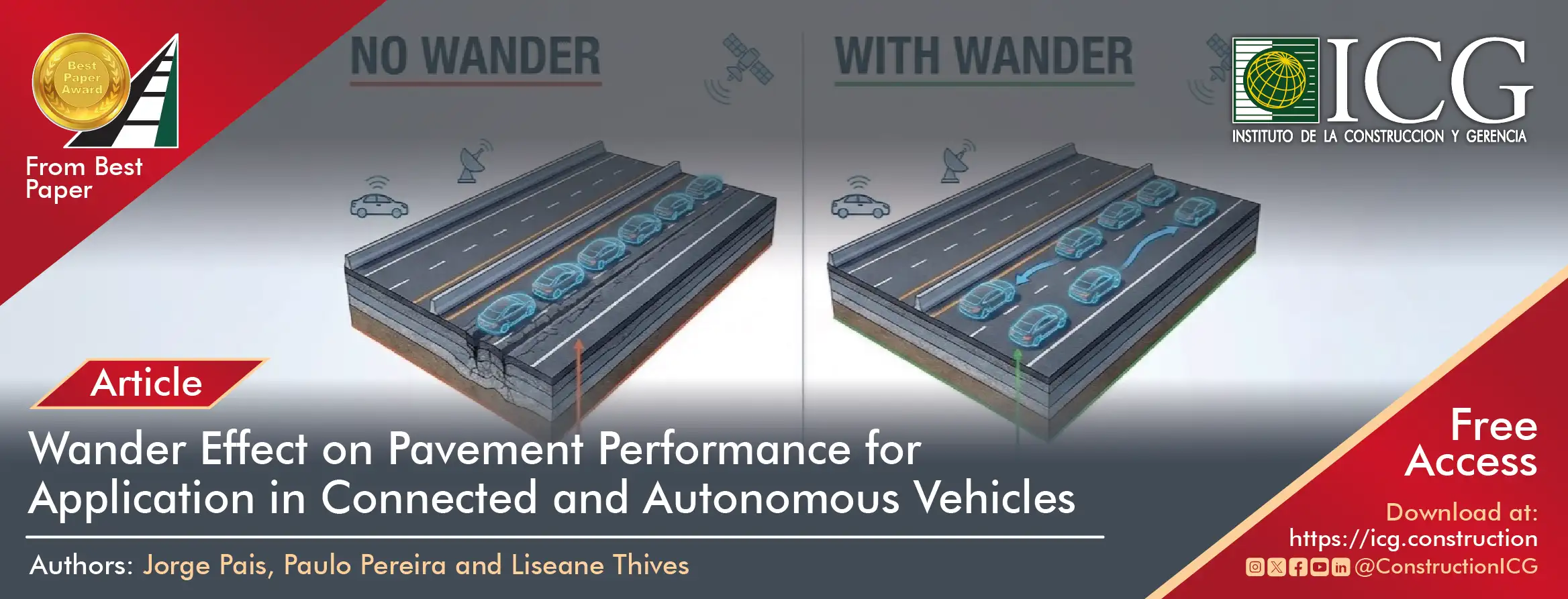
Abstract: Connected and Autonomous Vehicles (CAV) will change how road engineers design road
pavements because they can position themselves within a traffic lane, keeping their position in the
lane more precisely than human-driven vehicles. These vehicles will have lower lateral wandering,
which can induce more damage to pavements, such as cracking and permanent deformation, than
the conventional vehicles, with consequences for the infrastructures due to the increased cracking
and reduced safety due to the rutting. Thus, it is essential to assess the wander effect on pavement
performance to define policies for its implementation on CAV. This paper studies the impact of
the lateral wander of the traffic on pavement performance, considering its fatigue and permanent
deformation resistance. This impact can be used to define limits for the wander to minimize distresses
on the pavement. The results of this study allow us to conclude that for a pavement with a 10 cm
asphalt layer, the wander effect is more significant for fatigue life. A pavement life increase of 20%
was observed for a wander of 0.2 m, while for 0.6 m, the fatigue life can increase up to 48%. For the
permanent deformation, a pavement life increase of 2% for a wander of 0.2 m was observed, but for
0.6 m, the pavement life can be increased up to 34%.

Keywords: road pavements; connected and autonomous vehicles; wander; pavement performance

A video lecture is available for this article, which you can watch at the virtual 5-ICTI Conference.
You can purchase your access here.

Please note: This text is an abstract/summary. The complete original paper is available for download via the links at the bottom of this page.
Lessons Learned from the Construction and Initial Performance of a Double Chip Seal over a Paving Mat Pilot Project

Abstract: Single chip seals are used by many agencies to maintain or preserve their roadways.
While the construction and performance of single chip seals can be easily found from literature, the
construction of double chip seals with and without paving fabric or paving mats is still not common.
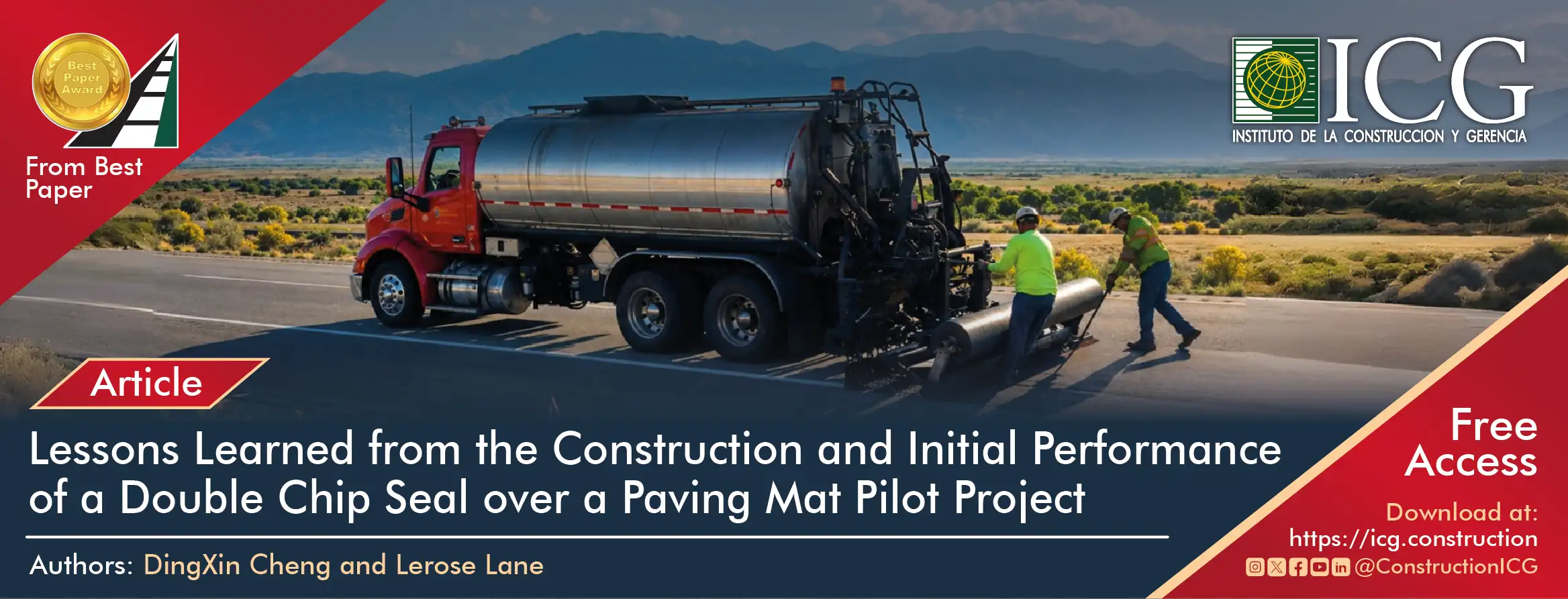
This paper investigates four double chip seal strategies used in a pilot project constructed on US 395
in Inyo County, California, by Caltrans. Within the double chip seal project limits, eight Performance
Evaluation Sections (PESs) using four treatment strategies were established for detailed performance
monitoring and evaluation: 1—a 3/8-inch asphalt rubber chip seal followed by a 1/4-inch PME chip
seal without pavement-reinforcing fabric (PRF) or a paving mat as a control section; 2—a 3/8-inch
PME chip seal over PRF, followed by a 1/4-inch PME chip seal; 3—a 3/8-inch PME chip seal over
a paving mat, followed by a 1/4-inch PME chip seal; and 4—an asphalt rubber 3/8-inch chip seal
over a paving mat, followed by a 1/4-inch PME chip seal. This pilot project was monitored during
construction and evaluated 1 year later to help identify any construction issues and was used to
improve the specifications and performance of Caltrans’ chip seals. This paper presents the initial
findings following construction, and the one-year performance of the pilot project and lessons learned.
The findings presented were accomplished by using these four treatment strategies on a highway
with a very adverse high desert climate type and high traffic volumes. Project reviews are also
planned for up to seven years to determine the long-term project performance.

Keywords: chip seals; double chip seals; asphalt rubber (type II); polymer-modified emulsion (PME);
pavement-reinforcing fabric (PRF); paving mat

A video lecture is available for this article, which you can watch at the virtual 5-ICTI Conference.
You can purchase your access here.

Please note: This text is an abstract/summary. The complete original paper is available for download via the links at the bottom of this page.
Properties of Hot Mix Asphalt (HMA) with Several Contents of Recycled Concrete Aggregate (RCA)

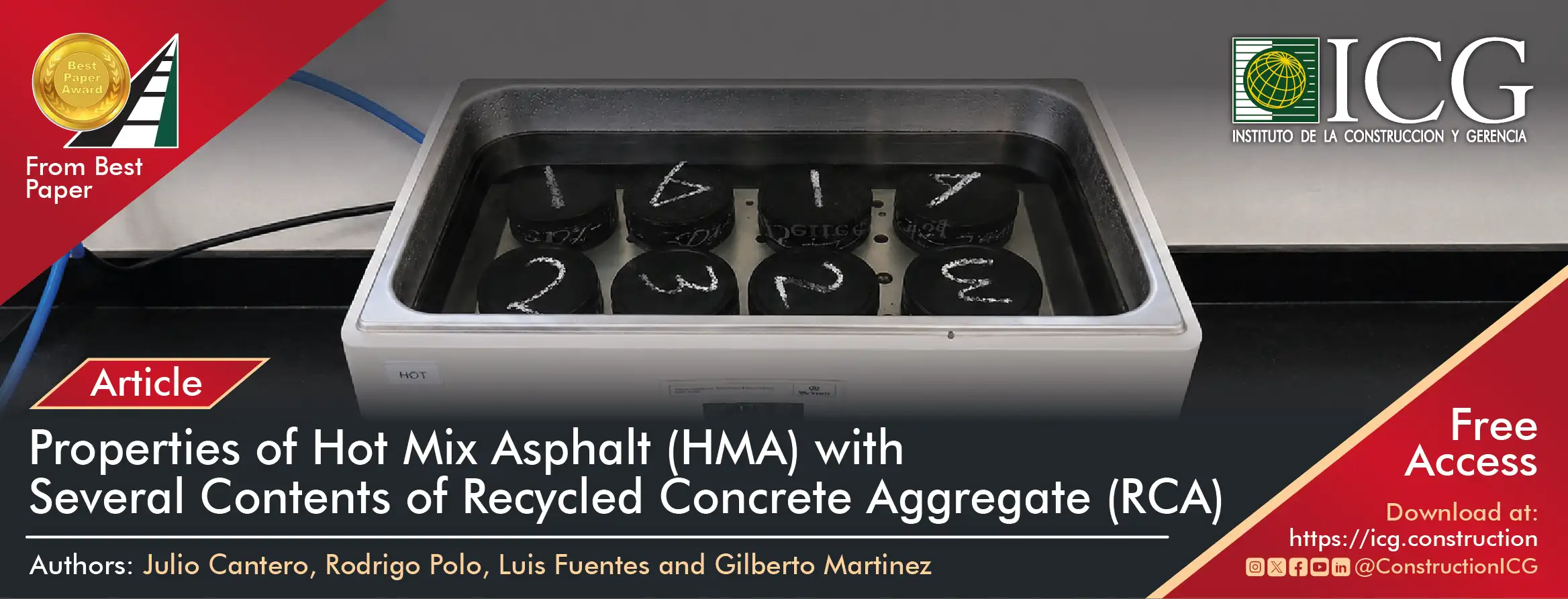
Abstract: Continuous research efforts have been developed in the literature to raise the sustainability components of the road infrastructure industry, i.e., reduce potential contaminants and augment financial profitability. In this regard, this investigation aims to explore the feasibility of producing Hot Mix Asphalt (HMA) with the inclusion of Recycled Concrete Aggregate (RCA) as a partial substitute for coarse Natural Aggregates (NAs). Thus, four different HMAs were considered, namely HMAs with coarse RCA contents of 0, 15, 30, and 45%. Specifically, the mechanical and sustainability properties of the asphalt mixtures were determined. On the one hand, the Marshall design parameters, resilient modulus, moisture susceptibility, rutting resistance, and fatigue life were addressed as mechanical properties. Meanwhile, regarding the sustainability properties, the environmental impacts and production costs were estimated using the Life Cycle Assessment (LCA) and the Life Cycle Cost Analysis (LCCA) methodologies, respectively. Consequently, the following conclusions were obtained: (i) as the coarse RCA content increases, the mechanical behavior of the HMA progressively deteriorates; (ii) this decrease in mechanical performance is acceptable up to a 15% RCA of coarse RCA, whereas for higher dosages this alteration is abrupt; and (iii) the RCA only generates sustainability benefits at a 15% replacement amount.

Keywords: Hot Mix Asphalt; Life Cycle Assessment; Life Cycle Cost Analysis; mechanical performance; pavement materials; Recycled Concrete Aggregate; sustainability

A video lecture is available for this article, which you can watch at the virtual 5-ICTI Conference.
You can purchase your access here.

Please note: This text is an abstract/summary. The complete original paper is available for download via the links at the bottom of this page.